Does ‘Mastery’ Still Hold a Place in Contemporary Art?
Art Club Magazine - Vol 1. (Print)
May 3, 2026
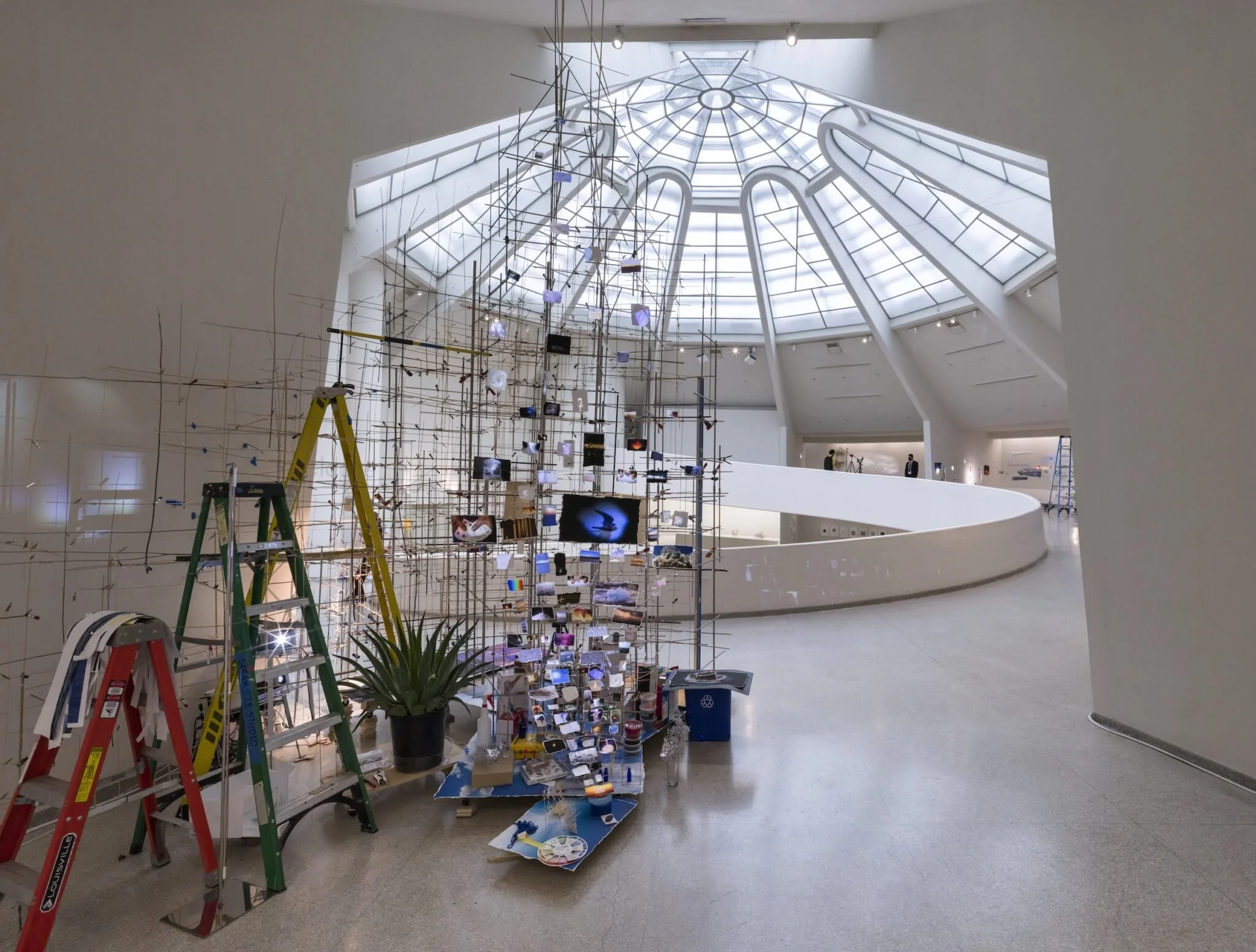
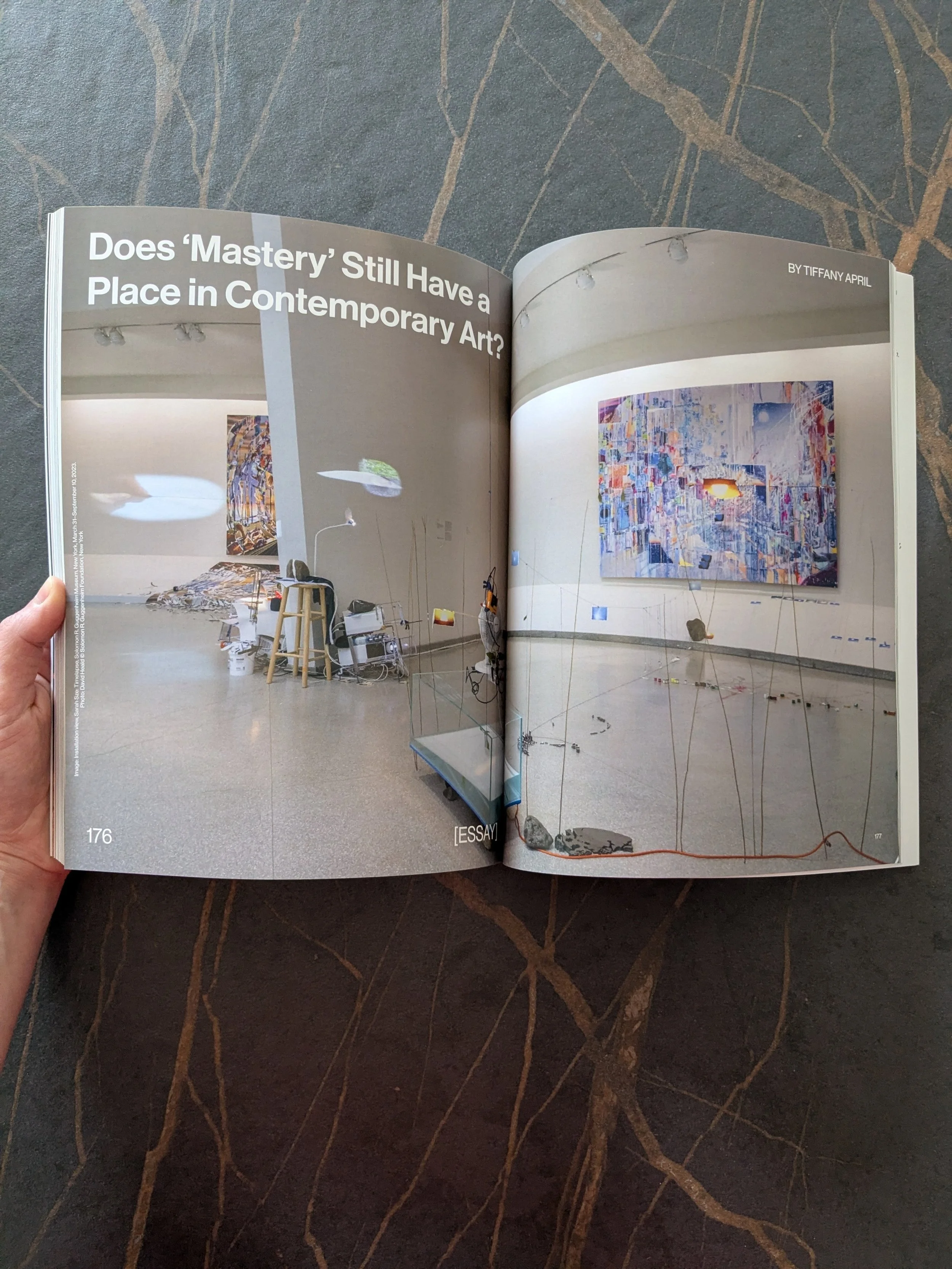
Installation view, Sarah Sze: Timelapse, Solomon R. Guggenheim Museum, New York, March 31–September 10, 2023. Photo: David Heald © Solomon R. Guggenheim Foundation, New York.
When I learned that the theme of this volume was ‘Mastery’, I noted an internal twinge of resistance to the term. I was surprised by this gut reaction and even more curious to examine it from different angles; to figure out why it felt so obtuse.
As an artist, naturally the term brings me to the focused practices of the Renaissance Old Master painters, trained in ateliers studying under reputable artists, at times for up to seven years. They would begin training at baser stages of paintings and progress to more difficult tiers only once they’d proven their consistent proficiency. The mastery they were working towards was mimesis – to recreate depictions of a person, object or scene so real the boundary between reality and image dissolves.
There is a general cultural understanding that mastery takes years, possibly decades of training. It speaks to dedication, impeccable craftsmanship, and a deep respect for the integrity of the object, image, or experience being created. All reputable characteristics worthy of praise. However, I quickly realized my aversion to mastery was because I associate it with perfection and control; more specifically, to be in control in order to achieve a set ideal. In craftsmanship, this usually involves yielding a tool or manipulating materials with complete precision to elicit a desired result; it is the glorification of perfection.
Mastery in art elicits a sentiment of unquestionable control within the power dynamic of the creation process, and demands a submissive counter role. To be the ‘master of’ requires those to be ‘master over’. It places the artist as the driving centrifugal force and relegates the matter they work with as subservient, unruly forces to be molded. Mastery, to me, feels like an archaic by-product of European colonialist dogma; oppression in the name of an absolutist worldview or subjective ideal.
The colonizer believes their way is the ‘purest’ and highest ideal, and attempts to shape those it claims power over to conform to its conception; it does not recognize itself as just one social, political or religious possibility among many. Colonialism’s sweeping exploitation of natural resources and redevelopment of land is rooted in the Enlightenment belief that ‘man’ is master over Nature. However, the increase in intensity and quantity of devastating weather events caused by our current environmental crisis alone should be proof enough that we are no masters of Earth’s materials or forces.
So if mastery in the studio is about controlling matter or materials with an ideal end goal in sight, what is that ideal and who gets to decide? Personally, I attempt to avoid clinging to the concept of mastery in my own practice; I find it stagnant and predictable. I have a roster of paintbrushes that I’ve come to know like the back of my hand. I know which of these trusty tools to reach for when I want to lay down a specific mark. At times this is helpful, when margins for error are thin, but the repetition of slick familiarity often irks me because it is the antithesis of what I search for in my own work and what I enjoy in the work of others.
When the urge to reach for the ‘safe’ tool emerges, I tell myself to pick the one least suited to the task, and try to use that to translate the feeling of the mark envisioned in my mind instead. Those results confound the ‘picture-perfect’ vision in my mind’s eye, and their unpredictability forces me to respond to the unintended.
The status of artistic mastery in the twenty-first century has shifted immensely since the Renaissance. No doubt there are cultures that hold fast to uplifting its tenets. Japanese culture celebrates dedicating one's life work to excelling at a singular skill, often passed down through generations. Whether it is bladesmithing or the perfecting of yakitori, there is a deep sense of pride in the pursuit of perfection.
Rapid technological advancements are squeezing out the time and financial resources required for mastery. The boom of artificial intelligence (AI) is drastically changing the general publics’ expectations around the speed of production, dissemination, and consumption of goods, services, and information. These days, much of the visual and written content on web-platforms has been birthed, if not kissed, by AI in order to keep pace with feeding the information machine of our society. ChatGPT and similar bots bombard us with AI generated images and videos – lovingly termed ‘AI Slop’ due to their rapid creation and complete vapidity – perpetuating the idea that the act of creating is as simple as typing in a description and hitting a button. The magic of instant gratification.
For artists, keeping up with the techno-capitalist pressure of constant creation and dissemination, and the rapid withering of audience attention spans can feel like trying to shoot a target made of glitter flowing down a stream. The overwhelming sentiment is that the pace of human creation, with its natural ebbs and flows, is no longer suited to the increasing sprint of society’s visual and consumer culture. We are eons away from the era of the Old Masters’ ateliers.
So where does mastery fit in this new world? For one thing, the time associated with mastering a skill is a direct denial of the frenzied techno-capitalist drive to produce at an ever-faster pace. From this viewpoint, mastery may in fact be an act of resistance – similar to the rise in advocacy for rest and slower living as radical activities within late-capitalism's hustle culture. In addition, the inevitable quality produced by a culturally relevant and well executed artwork is also a direct opposition to the meaninglessness of AI Slop. But can the slow pace of mastery survive in the hamster wheel of contemporary demand; ever-more options, faster production, and at an economical price-tag? Mastery is associated with higher cultural and market value, which is gradually becoming less and less attainable to the shrinking middle class and accessible only to the wealthy or ultra-wealthy – consequently also a shrinking number. So who is mastery really for and does it still have value?

Installation detail, Marianne Chenard: Drawing. Glacier, Photo courtesy of the artist, 2021.
I often tell my students that they need to learn the rules in order to break them. Cézanne didn’t wake up one morning and disassemble linear perspective and Euclidean space from thin air. In this sense, I believe that mastery within a craft plays a very important role, but that it should never be the end point. If anything, it’s the starting line. When you have mastered a skill, that is when the ‘de-’ and ‘re-’construction can begin, where creativity and invention can take the lead in search of unknowns. In my opinion, when you allow yourself to leave the predictable and invite in chaos, that is when truly new explorations and expressions are forged.
Mastery and chaos, though competing forces, might need to go hand-in-hand. To access an effective level of entropy – because creativity is entropic – you have to have refined the skillsets that ground your practice; they are the tether that keeps you oriented and your work from sailing away into the meaninglessness that lurks within chaos.
‘Entropy’ originates from the English ‘en’, meaning ‘inside’, and the Greek ‘trope’, meaning ‘transformation’. Effectually, chaos is an ‘inside transformation’. You can’t have an inside without some form of definable boundaries, and a transformation is the space between one state and another. Though it may be fluid, it requires a jumping off point.
Nature is the ultimate example. It is the most creative being we know, evident in its millenia of evolutionary developments. Randomness, aka entropy, is the cornerstone of its creation. We have no way of knowing if Nature creates with an end goal of perfection, as was suggested by Enlightenment and Darwinian philosophies. We probably won’t ever know. But evidence suggests that its creativity is not led by the domineering seed of ‘mastery’ but by an active process of responding to shifts – whether global temperatures or biological pathogens.
The planet and our universe are governed by systems structured on scientific forces and mathematical patterns. However, these are not absolute ‘universal rules’; the flexibility of DNA being one example, and the impossibility of definitively predicting weather patterns another. Nature’s built in allowance for randomness is what fuels transformation within these systems, based on a constant reciprocal conversation with forces outside of its control. That conversation is creativity.
So where does that leave mastery? Though I don’t believe one can 'master’ chaos, I do believe it is possible to become the boundaries of chaos, the edges that define the ‘inside’ of entropy; to form the space that allows transformations to occur. I see these entropic spaces being created by artists who accept a playful use of materiality; reveal or foreground the creation of their work; collaborate with organic materials and processes; and utilize ‘de-skilling’ involving raw or poor quality materials and ‘messy’ craftsmanship which divert the predictable refinement of mastery.
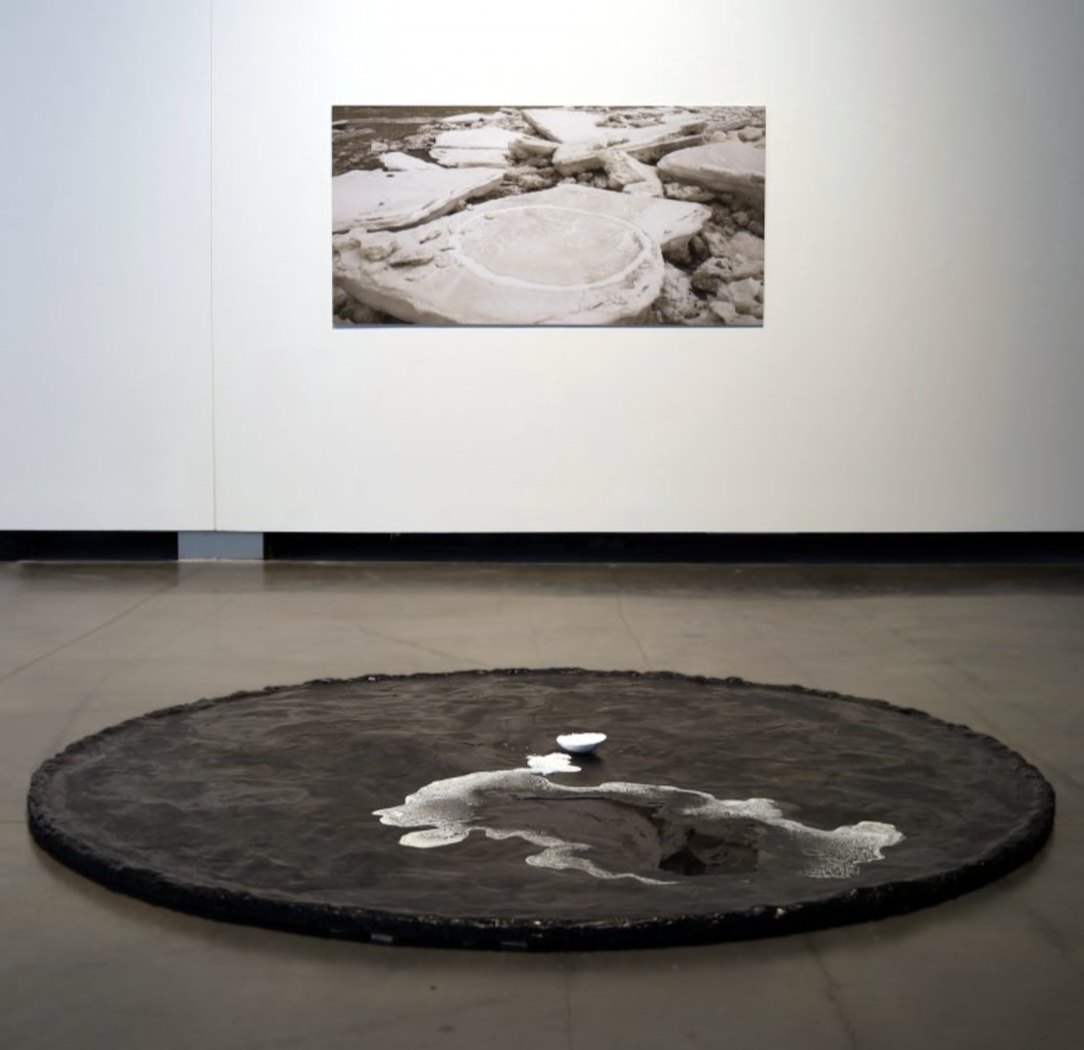
Installation view, Marianne Chenard: Drawing. Glacier, Photo courtesy of the artist, 2021.
These methodologies shift the role of the artist into the creator of structural parameters within which materials and matter can organically interact or transform. The removal of the ‘hand-of-the-artist’ in favour of the natural creative agency of materials and elemental processes is evident in artists working collaboratively with organic and lively matter; such as Annie Thibault’s practice of working with live fungal and bacterial cultures in glass vessels and petri dishes; or Marianne Chenard’s combining of salt, soda ash and melting ice to create slow-forming crystallisations within shallow beeswax bowls.
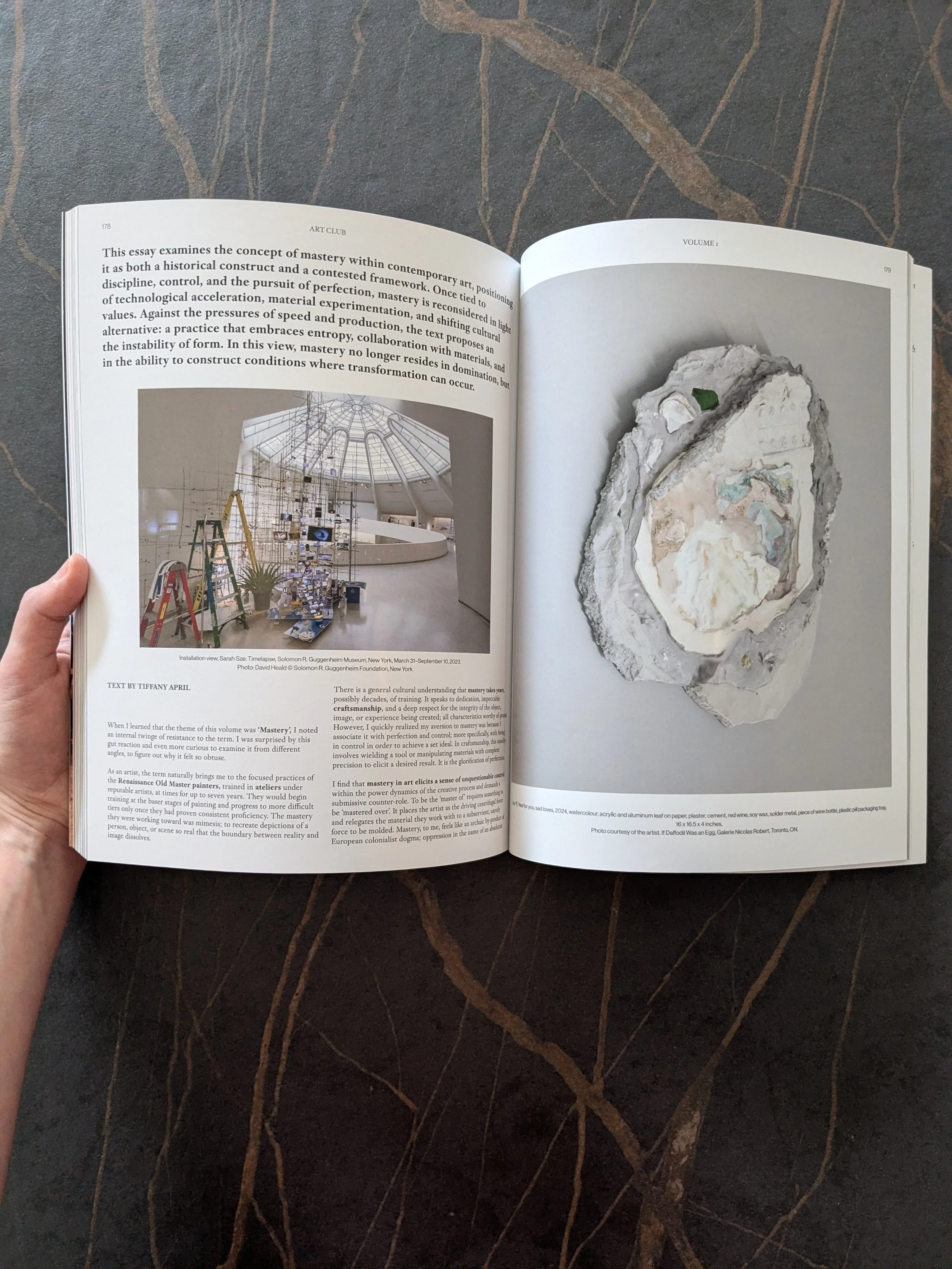
Laur P accepts chance material interactions in his work, combining non-living materials like fiberglass, paper pulp, fragments of plaster casts, resin, acrylic paint, trans tape, steel wool, rhinestones, pill bottles and cigarette butts amongst other debris from the artist's daily life. Their amorphous forms, solid puddles on the floor, read like topographical landscapes defined by materials merging with or resisting one another. Their contents, subjected to the temporary fluidity of pulp and resin, are frozen in place, arranged according to the whims of weight and viscosity, like fossilized fragments from an archeological dig.
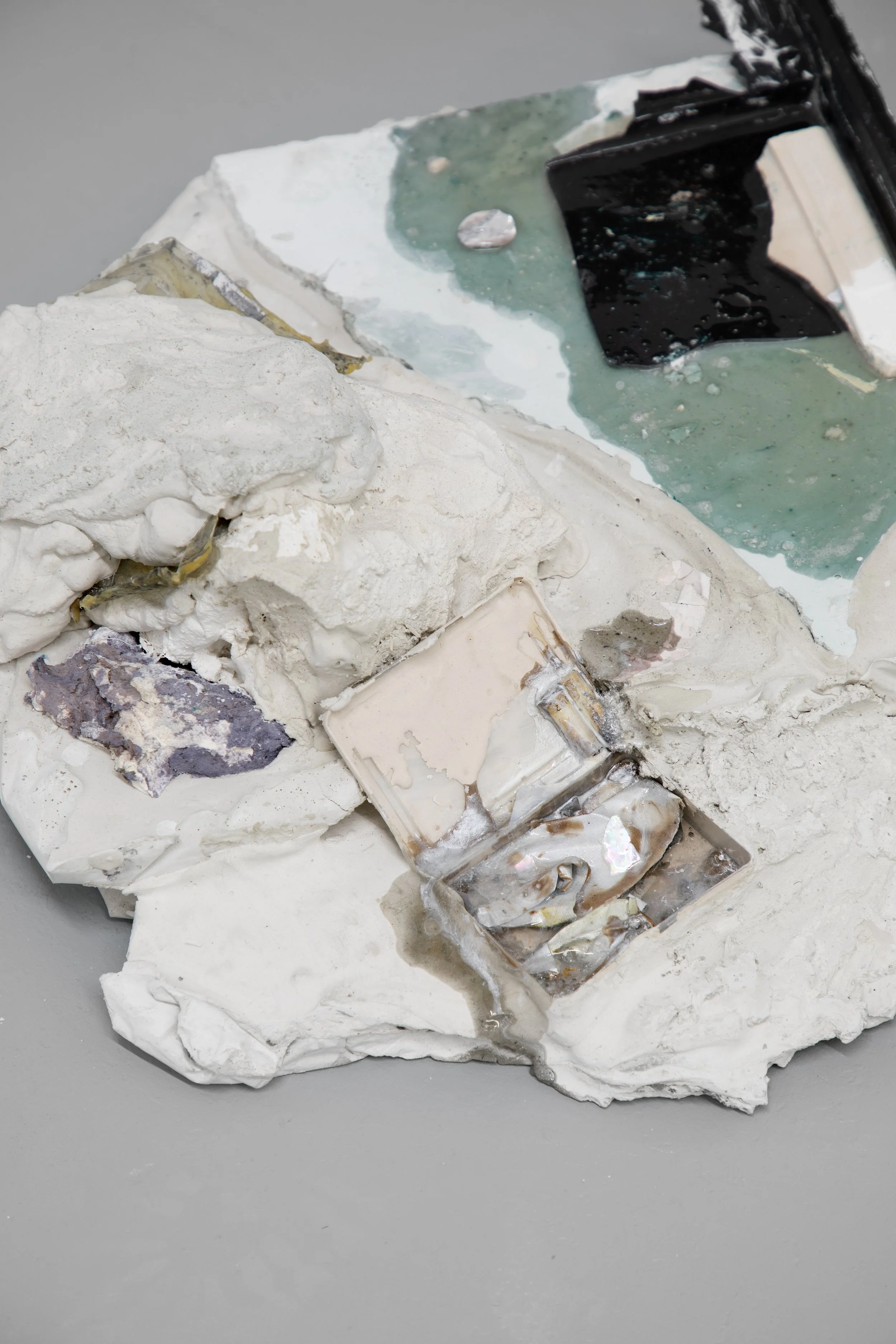
Laur P, Those who made it through ages and those who couldn’t (detail), fragments of plaster casts, epoxy resin, paper pulp, dry pigments, piece of plastic tray, solder metal, plaster, concrete sand, aluminum foil seal cap, plastic container, cigarette butts, flakes of abalone shells, latex mold of a carton box, 19 x 18 x 6 in. 2024
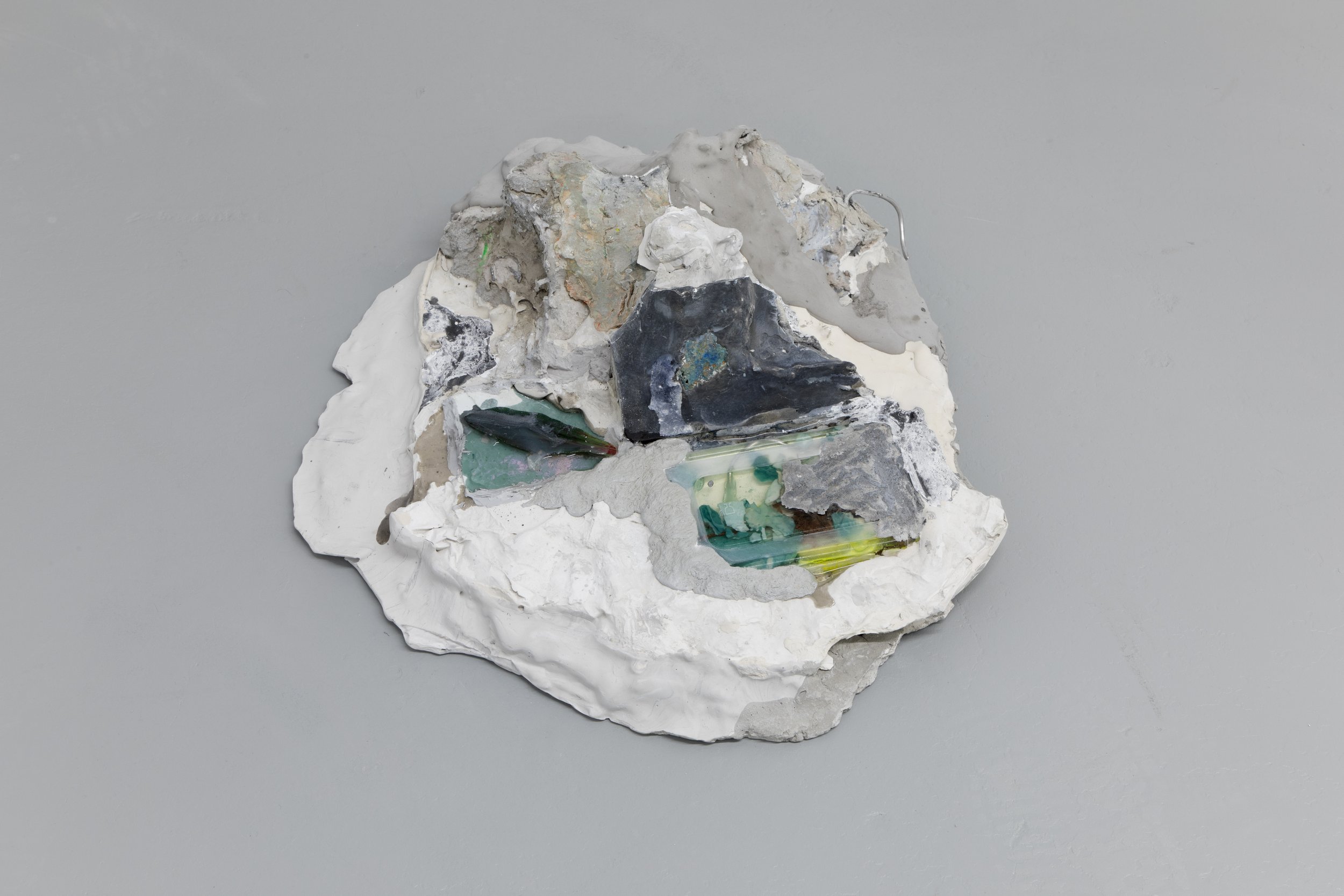
Laur P, When the rays sweat a softer kind of anger, plaster, cement, paper pulp, dry pigments, metal wire, plastic glass, plastic sheet, solder metal, plastic lid, epoxy resin, oil-based ink, dead leaf, oil paint residues, two pills of Citalopram 20mg, plastic leaf, concrete sealant,
20 x 18 x 6 in. 2024
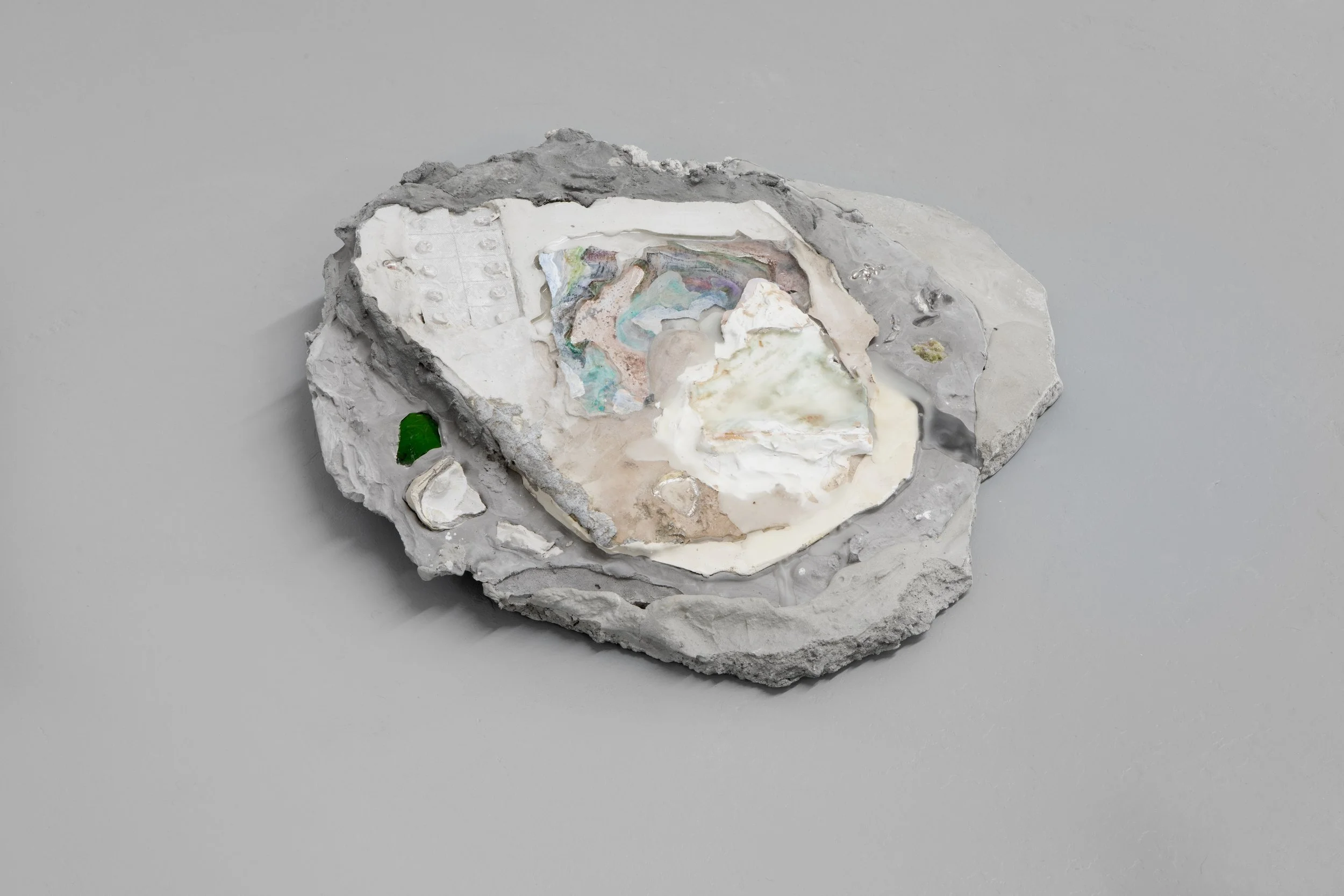
Laur P, I feel for you, sad loves, watercolour, acrylic and aluminum leaf on paper, plaster, cement, red wine, soy wax, solder metal, piece of wine bottle, plastic pill packaging tray, 16 x 16.5 x 4 in. 2021
With material play comes a parallel surge in revealing the artworks process or artwork-as-process; the idea that how the work came into being is as integral as its end result, if not its epicentre. For example, Sarah Sze arranges her immense and intricate installations to feel precarious, baking entropy into their structure. Flimsy or everyday paraphernalia like popsicle sticks, string, clamps, ladders, photographs, projections, paint, and plants pile atop one another. Their delicate balance threatens to collapse at any minute or continue growing. Often multiple video projectors are installed to rotate at varying speeds, using time and velocity to introduce unpredictable interactions and overlaps of images and materials, mimicking processes of meaning making and memory.
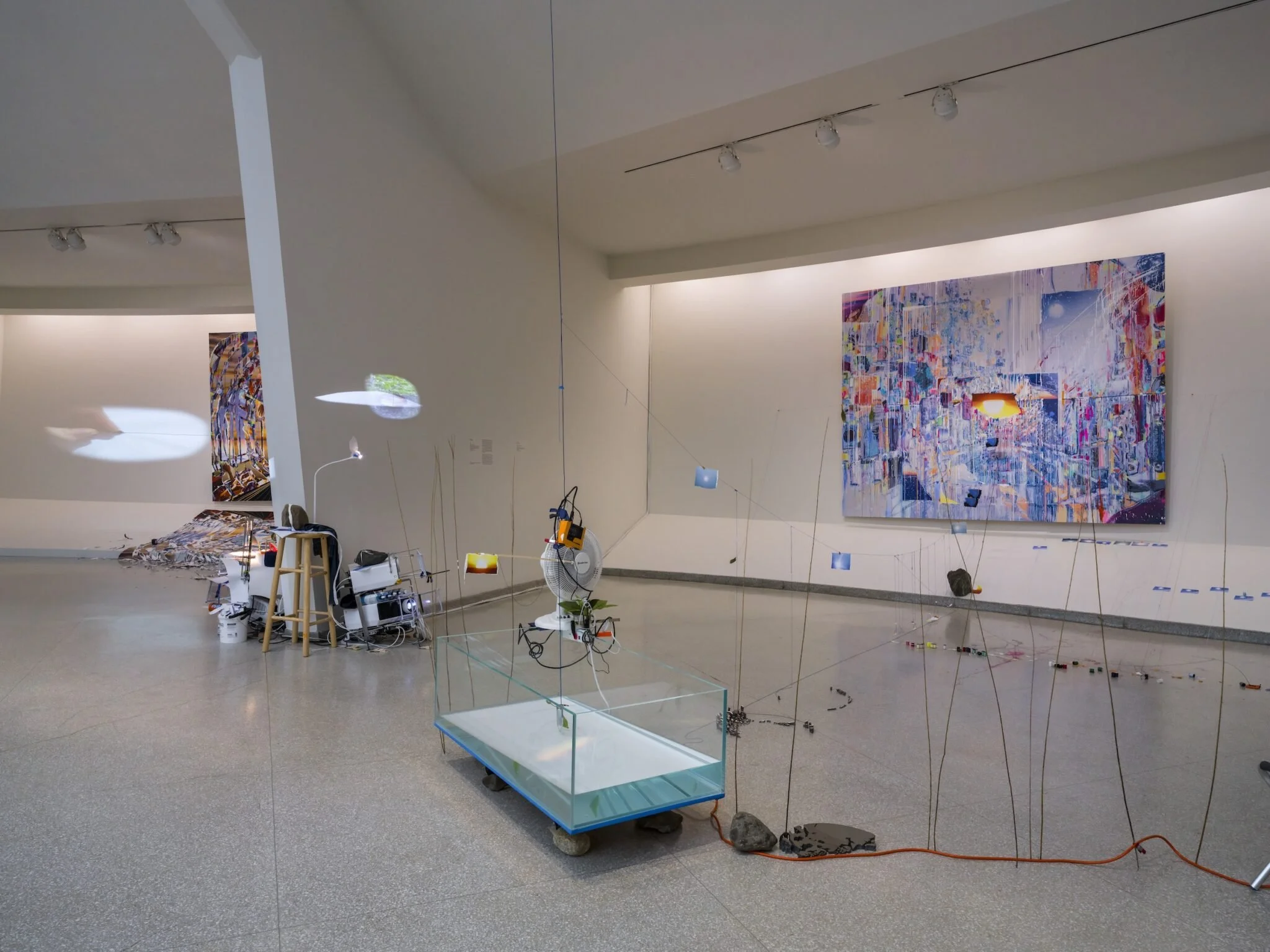
Installation view, Sarah Sze: Timelapse, Solomon R. Guggenheim Museum, New York, March 31–September 10, 2023. Photo: David Heald © Solomon R. Guggenheim Foundation, New York.
Purposeful ‘de-skilling’ is another invitation for the entropic. Martin Golland’s mixed media paintings on paper, featured in I built this garden for us (2022), were created in a studio process resembling the organic decomposition of compost. Golland’s desire to unlearn Western academic notions of image building, and his acceptance of the relational rather than the stand-alone artwork, led him to a generative studio method of mulching imagery, processes, and materials. He continually defaced or destroyed his images through material and physical interventions of sprays, bleeds, scrapes, and cuts until they fermented into unexpected forms with a life of their own. Displayed together in the gallery space, their shared origins of cross-pollination allowed them to refuse compartmentalization.
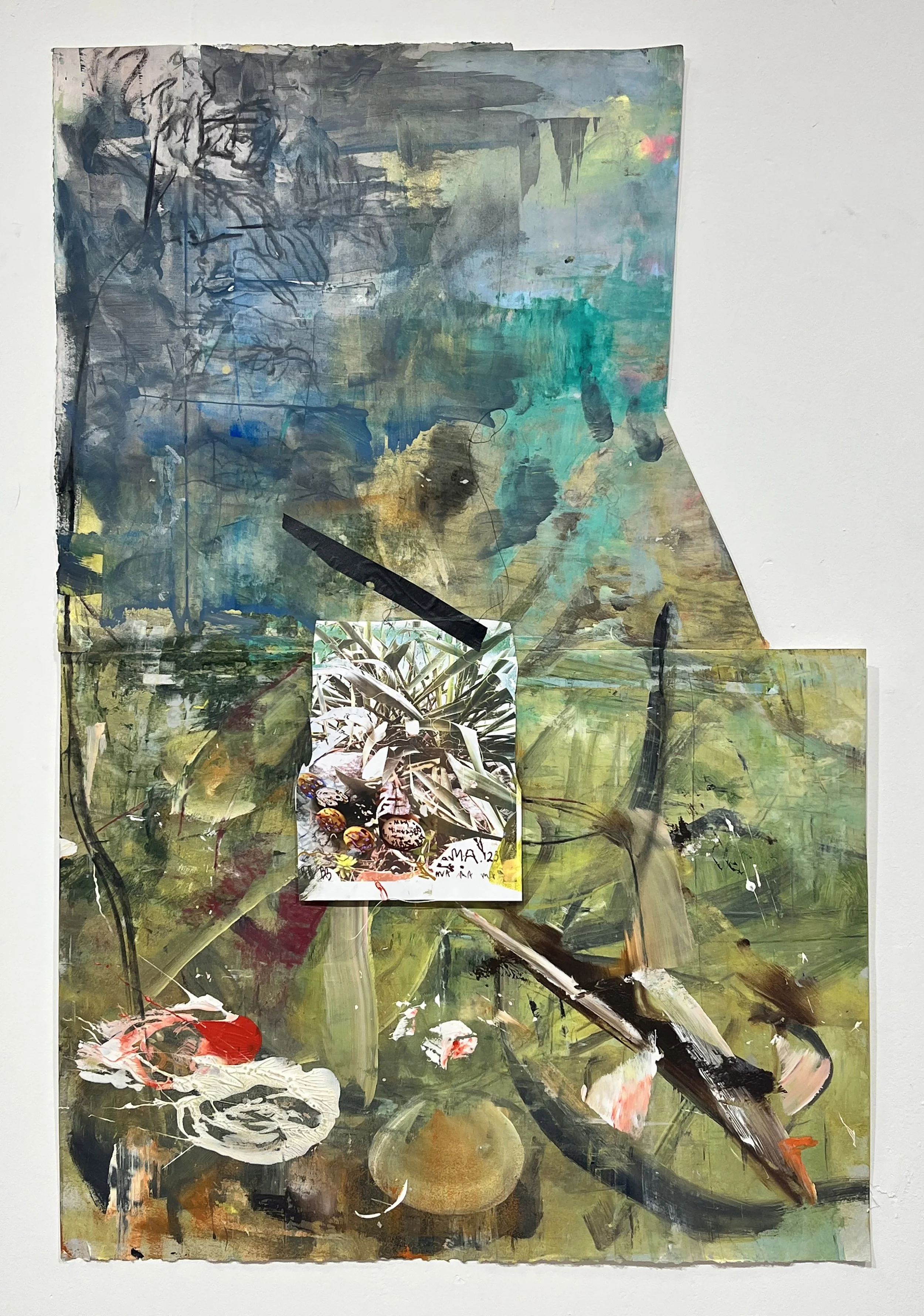
Martin Golland, Shallow Seed, mixed media on paper,
45 × 30 in. 2023
Each of these methods welcome randomness and position the artist as one entity within the conversation of creativity, not the masters of it. Their slow formation and reciprocal nature exist as radical resistance to the pressures of our content-driven information society. We are currently living in a world of increasing dictatorships and nationalist, imperialist governments who demand uniformity, rigid order and obedience to master control over their populations. Chaos and creativity open the imagination to other possibilities. They are the acceptance of plurality; the co-existence of many simultaneous realities, not a singular ideal. This may be a more important time than ever to lean into chaos. Mastery’s place within contemporary art practices appears to be as a wall to push against, or propel off of. It seems to me it is less a question of mastery’s value, but the value of how it is used.